I'm still pursuing avenues for my creative writing, but I also have bills to pay -- including the one for this site! So I went back to content writing -- which can be creative in its own right, depending on the job -- and I also started using Listiller (https://listiller.com/).
Listiller is large and impressive, with all kinds of jobs for freelance writers. Although I am admittedly new to the site, there's a bit of a learning curve and I am still finding my way around. There is a very affordable subscription plan, but Listiller is free to use.
More importantly, Listiller has an active community of freelancers in addition to the opportunities it posts -- which is great, because freelancing from home can get really lonesome. It helps to have someone to talk shop with.
It looks like Listiller could become the hub for my freelancing efforts. With its robust profiles, tons of job listings, and community of freelancers, I find myself hanging-out there more and more often. Being new to the site, I haven't engaged anyone directly yet, but I am following a few conversations. (I'm lurking, y'all!)
Also, I have already found work through Listiller! So I can vouch for its efficiency.
Even if you don't freelance (why not?), I highly suggest checking out Listiller. You never know what you'll find -- but, if you're looking for a writer, or you're a writer looking for a job, Listiller is where you should be looking.
© C Harris Lynn DBA The Weirding, 2019
Happy World Book Day, everyone!
It's been quite a while since I last posted, and I apologize for that. I hope to be here more often, though not necessarily on a regular basis.
I acquired a number of books lately, including several I've been trying to find for years. Almost all of these are pertinent to this, or another, project, but I also found a slew of recent Stephen King books I didn't have for $1.00 - $3.00! Hardcovers, to boot!
I started listening to more audiobooks, too. I'm still adjusting to it: It's nothing like actually reading a book, but it beats talk radio... usually. It's actually pretty great, since I can do other things while listening. And podcasts and talk radio are still fine, sometimes.
Currently, I am making my way through several selections, including The Darkening Age: The Christian Destruction of the Classical World by Catherine Nixey; Doctor Sleep, Stephen King's sequel to his seminal The Shining; and Camelot 3000, a cult classic in comics that I missed as a child, and finally found at a reasonable price.
But I picked up literally dozens of new (to me) books for pennies over the last few years, including all of Jules Verne's works (collected); all of HP Lovecraft's works (collected); all of Mark Twain's published writings (collected); and more, as well as non-fiction focused largely on writing, creativity, cookbooks, and so on. Most of these are digital, but I found an awesome used bookstore about an hour from me, and got a lot of hardcopy, too. Got a shitload of magazines, as well.
My schedule is exhausting just to think about, but World Book Day gives me a great excuse to spend some time reading.
© C Harris Lynn DBA The Weirding, 2019
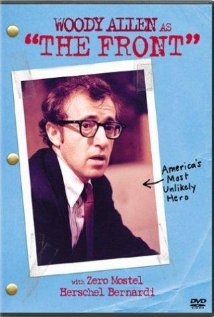 |
| The Front |
Woody Allen stars as a small-time slacker who becomes a front for several Blacklisted Hollywood writers, placing his name on their work.
The Front is a 1976 dramedy based on real-life events which did not age well. Woody Allen is his Woody Allenest, and the screenplay is humorous, but the "farcical" slapstick comes across as forced pandering. The juxtaposition of comedic styles fails the film -- as do the dramatic scenes, which also feel obligatory. The writing is capable, but nothing stands out, and it misses almost every opportunity the premise grants. The most important aspect of the film is the subject matter, and it does a decent job with that... for the little time it is given.
SPOILERS
The Front is an important film -- not just because of its subject matter, but also its cast and crew. While still relevant, the movie does not hold-up well.
The Front is a 40-year-old film about events that occurred 25 years earlier, and while that was part of the movie's charm in its day, without historical context, much of this is lost on the audience. It has a lot of ground to cover, but -- since the subject matter was recent, and still controversial, in 1976 -- it forgoes that to tell a love story.
That's the film's biggest flaw: A movie about TV sit-com writers using a bumbling, barely literate, bookie as a front which focuses on the main character's love life is 90 minutes of missed opportunities. Further, most of the romantic scenes rely on Woody Allen's signature cerebral anxiety -- too much of the movie does, in fact (as do all of Allen's films) -- where The Front should instead have emulated the dialogue, plots, and sensibilities that were prevalent on TV in the 1950s to satirical effect.
The movie lampoons its subject, but the humor is subversive, with that "insider" feeling all showbusiness films have. To its credit, this much of the movie is great -- the jokes are dark and crisp, and the barbs sting even today -- but most of it is lost to the time and focus given the romantic angle. In fact, were The Front a TV sit-com episode itself, the actual subject of the movie would be the B-story to the love story.
The movie feels anachronistic in general, but I'm no expert on the '50s or '70s. It may be the color palette, clothing styles, phrases employed -- I'm not sure -- but it seems like it was trying to be current while capturing the feel of a bygone era in a timeless way, and it fails. We see this a lot, even today -- a period piece filtered through modern sensibilities -- and these movies rarely age well, especially when dealing with timely and/or controversial issues. In fact, the sensitivity of the issue may well be the reason the movie focuses on the romantic plot.
The Front's confused tone should be redeemed by the revelation that many of its collaborators were themselves victims of The Hollywood Blacklist, but it isn't. The ending is anti-climactic and unsatisfying. It could be interpreted many ways -- his testimony changed nothing, but he got the girl and that's what matters; political correctness as a tool of oppression and censorship is an ongoing issue; you all know how the story goes, so we'll end our show here -- but it plays like they ran out of money and just pulled the plug.
What should have been a scathing, satirical farce of history, politics, and the TV industry is instead a mediocre, slice-of-life, everyman-as-hero rom-com. The Front had a lot of potential it did not live up to, but political pressure and the prevailing attitudes of the time may be to blame.
© C Harris Lynn DBA The Weirding, 2017


